Showing posts with label boutique. Show all posts

Monday, 18 January 2016

A History of Wal Basses - The Movie

Of all my favourite memories of 2015, one of the longest lasting will be a Saturday in September spent at the "Basschat South East Bass Bash 2015". This was a gathering of members of the fine discussion board, Basschat - a fine place to hang out and talk about all things bass. And indeed, it was a fine day to hang about with some like-minded bass players, shoot the breeze, check out each others' basses and generally geek out. I'm not going to blog about the day itself because that job has already been done brilliantly by the music blogger, Bluejay, also a keen Basschatter.

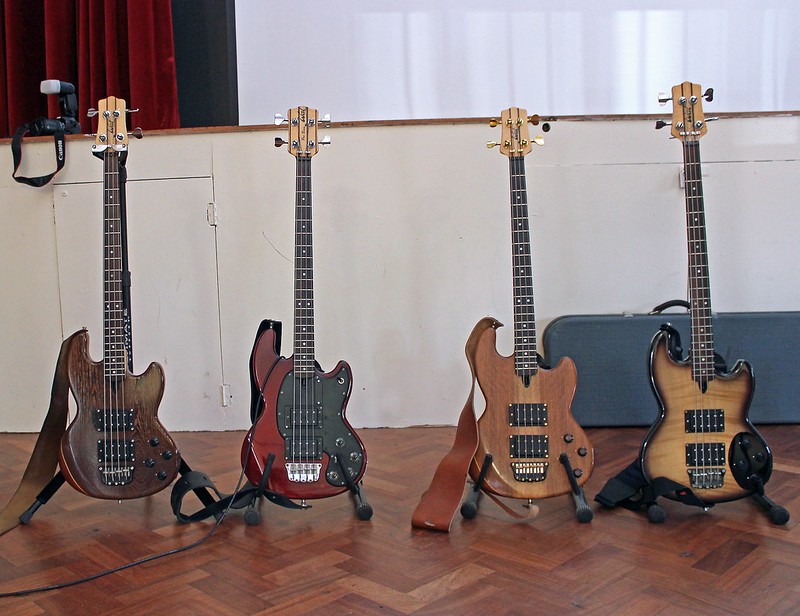
Here are the quartet which were there that day...
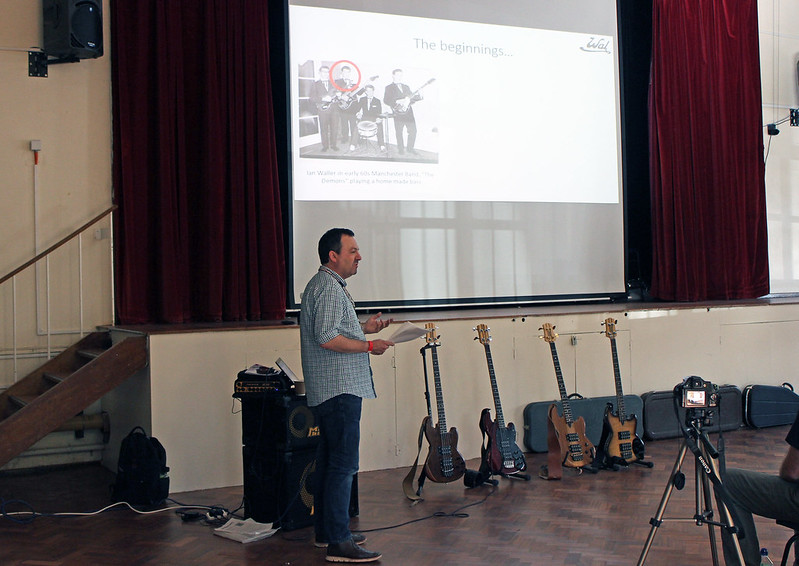
But I wasn't just there to shoot the breeze. The main reason that I as there was that I had been invited to give a talk about Wal basses - a run through the history of the brand. Alongside my own two Wals a number of other attendees had brought theirs - a lovely Wenge Mk 1 Custom and a Reissue Pro bass which had been retrofitted by Wal with Custom Series bass pickups and controls - a truly unique bass. The talk gave me the perfect opportunity to tell those assembled about the history of the brand and to demo a few of the qualities which make Wal basses so unique. 

Fortunately, Bluejay also video'd the talk and posted the it on YouTube for posterity. So here, for your viewing pleasure, a trilogy in four parts of "The History of Wal Basses". Here is the first of the four videos...


Thursday, 27 August 2015

Gallery - Reissue Pro Bass

Gallery: Early and mid 1980s reissue passive Pro basses

Andy Baxter, of Andy Baxter Basses in London takes some amazing photos to display the basses which he has on display in his shop. This includes a number of lovely Wal basses. He has kindly given permission to display some of these on this blog. This gives a really good representation of the various models in the Wal range over the years. The ones displayed here give a really good representation of how the details of these basses changed over the years...

1982 reissue Pro bass:  


Monday, 4 August 2014

Wal MB4 midi bass review from Guitarist magazine - February 1990

Wal MB4 midi bass review from Guitarist Feb 1990


ELECTRIC WOOD
Wal MB4 MIDI Bass

As MIDI controllers grow in type and in complexity, one instrument seems to have been overlooked - the bass guitar has always been the 6- string’s poor relation... Review by Ollie Crooke.


AS A BASS PLAYER who works a great deal in a MIDI pre-production studio, I have spent the last few years gnashing my teeth in jealousy as controllers for drummers, guitarists, saxophonists and trumpeters have come on to the market; there just didn’t seem to be much commercial interest in making MIDI accessible in any acceptable form to bass players. I contacted Yamaha, who make guitar and saxophone controllers (both of which I have bought in frustration) to ask if they had any plans to develop something to help me, and was told that although the technology was of course available, such a development was highly unlikely, as there was not a sufficient market to make it worth their while. Well, I hope this instrument proves them wrong.


I am hardly unbiased, but I believe that the potential of a MIDI bass controller is immense - even more so when coupled with a machine like the Simmons SDX and a good drummer. Whole rhythm sections can be recorded into a sequencer, edited, looped, tightened up and generally manipulated, giving whatever balance of human feel and computer precision you require. Exciting, eh? Like drums, although great bass parts can and have been programmed from a keyboard, most of them don’t sound the same as if they’d been played by a real bassist or drummer. Neither is there any of the spontaneity or interaction generated by a good rhythm section playing together. And as there just happens to be a Simmons SDX lying around in my studio, perhaps you can understand my desperation for a decent MIDI bass controller...


Monday, 14 July 2014

Wal custom built basses, rarities & oddities...

Wal custom built basses, rarities & oddities


Throughout their history, Electric Wood were known for their custom builds alongside their production models. Whether it was the iconic triple neck or a tweak to the established formula, if you could convince Ian or Pete then the world was your oyster. However, they had to be convinced it would work. They remained craftsmen, dedicated to building beautifully crafted working tools for working musicians. The weird and wonderful but frankly silly basses could be left for other builders. 


When visiting their workshops in High Wycombe it was not so unusual to see the odd Strat shaped guitar (albeit sporting the characteristic Wal laminated body) hanging from the guitar rack. Alongside might be a Jazz bass in for renovation. However, despite that their passion remained for the basses for which they had become known.


There were a few oddities, though. This page showcases a few of Wal's more unusual creations.


Monday, 7 July 2014

Wal Double Neck Basses


Double-necked Wal basses.

Over the years Electric Wood have made a number of double-necked basses.  Although not exactly common there are a good few examples out there.  
 
The original idea for a Wal double neck came from renowned bassist, Jonas Hellborg, who approached Wal in 1983 with the idea of building a unique bass which
combined fretted and fretless necks. Of course, Wal had some history with multi-necked basses having built the iconic Wal Triple Neck for Roger Newell in Rick Wakeman's band in the early 1970s. The triple neck was, however, somewhat "agricultural" in its lack of finesse. It predated the development of Wal's proprietary pickups, electronics and bridge using off the shelf components. Hellborg's double neck was to be a rather slicker affair.

Monday, 30 June 2014

Bassist magazine feature, January 2000 - "My bass(es) are... Four Wals"


My Basses are...   Four Wals

Steve Weston wanted a Wal. Then he wanted another. And another. Then? Well, we'll let him tell you...

I will never forget the first time I heard a Wal, it was in 1983 and being very ably played by Colin Bass of Camel. I'd had a number of basses over the years, Rickenbacker, Fender, Ibanez etc, but had never quite managed to capture that elusive sound that I wanted from any of them. Anyway there I was watching Camel and I was suddenly being blown away by this amazing bass, loud in the mix without being overpowering, driving, clear and very tight. I decided then and there that I had to have one.
Anyway as it turned out, deciding I had to have one was the easy bit. It actually took me two years of saving, gigging on reduced curry and beer intake (slightly) before I had enough cash to realise my dream, a 1984 Custom 4 string purchased from a reluctant seller in London.

The bass as it was then had a Mahogany body, Electric Wood standard, with Walnut facings and an ebony fretless fingerboard, great looks, and yes, it had that great fretless Wal sound which suited me exactly at the time due to the material we were playing. I later had luthier Pete the Fish at Electric Wood make me a fretted neck so I had some opportunity to change style from time to time. In one form or the other it was my only bass for the next 6/7 years and it never let me down once.

Monday, 16 June 2014

Video Demos

Just what do all those knobs do?

We Wal fans all know just how versatile the Wal bass is - largely down to the visionary design of the active electronics. There are so few other basses that have ever used the type of filters which a Wal Custom bass uses. So if there is a downside to the versatility upside of the Wal tone circuit then it is that the way in which they work may not be familiar. They aren't immediately intuitive to all.

The Wal Custom tone controls are described in more detail in the page on this blog that covers those models. But the drafting of those instructions aren't exactly user friendly. However, the beauty of the internet is that there is a wealth of info out there, particularly on YouTube. 

Here are a few videos of Wals in action. Enjoy.

First up is a video by Jaymi Millard, a serial Wal user and serial groovy bass reviewer on his YouTube channel. Here he is reviewing a 1985 Mk I four string...


Monday, 2 June 2014

My basses: 1978 Wal Pro series bass - PB1291


1978 Wal Pro series bass - PB1291: 


My Pro bass is a "Pro IIE" which was, according to records at Electric Wood, completed on 24 September 1979.  The Pro Series was Wal's first production bass line (hence "Pro") and the IIE signifies twin pickups and active circuitry. Like my Mark I Custom Series Wal this is another beautifully built bass. It has a translucent (strawberry) red finish over a solid ash body that the photos simply do not do justice to.  It is so rich! The body shape and size is similar to the "Custom Series" basses although the forearm chamfer is much more angular than on the Custom Bass. The neck is much the same construction as the newer Wall basses, although with a larger "paddle" style headstock.  However, the neck profiles are quite different - the "Pro" has a comfortable and fast C shaped neck while the "Custom" is rather more "V shaped".  In addition, the neck features carbon fibre stiffening rods within the construction of the neck.

Sunday, 25 May 2014

My basses: 1985 Wal Custom 4-string bass - W2601


I am lucky enough to have what I consider to be a small but perfectly formed collection of bass guitars. First of all I'm the owner of two bass guitars from one of Britain's most respected builders... Wal Basses by Electric Wood.  These are a beautiful red "Pro series" bass from 1979 and a schedua topped  "Custom series" bass from 1985.  I also have another British-built bass, a custom built acoustic bass made by the luthier, Tony Revell, from the south of Wales. Alongside that I've got a couple of other lovely basses, an old Aria SB700 (my first ever bass - awww!) and a customised Jazz bass copy with an interesting story to tell. First up is my main bass for over twenty years, my 1985 Mk I Custom series bass.


1985 Wal Custom 4-string bass - W2601: 


Saturday, 8 September 2012

Introduction and a brief overview of Wal basses

Welcome to my Wal History Blog...

Over the last few years I've gained a reputation as a bit of a geek-meister on the topic of my favourite bassess - the wonderful Wal basses made in High Wycombe by Ian Waller and Pete Stevens through the 1970s, 1980s and (after Ian's untimely death in 1988) the 1990s. I'm a Wal player myself, regularly using my two Wal basses (a 1979 Pro Series Bass and a 1985 Mark I Custom Series bass) playing at church or in the function/covers band of which I'm part.

My basses are working basses - tools of the (amateur) trade - and have become very personal to me over the nigh on 20 years I've owned them. However, they are also fine examples of the master (bass) guitar builder's art. As such their history seems to me to be worth chronicling. For a few years I have had a Wal History site elsewhere on the internet and this has become something of an accepted repository of info on these fine basses. However, an impending possible change of ISP places the site's current web space in doubt. On that basis it seemed to be an ideal time to revisit the site, revise it and to transfer it into a more modern, permanent format here on Blogger.

      
Over the coming months I plan to populate the site here drawing on the pages already there on my original site. If you have a quick look at the Site contents page (linked to the left...) you'll see that there's quite a bit planned. So please do pop in on an occasional basis to see how far it's got. There are just a few pages populated already (including some bits and bobs which you've not seen before) with more to come. If you're interested in the kind of thing which will appear here I've cut and pasted the Intro and Overview page below.
The site can best be navigated using the pages listed in the sidebar to the left or by going to the Site Contents page where all the content will be permalinked from the index. 


Hope you enjoy the site.
Trevor

_________________________________________________


Introduction.

Wal basses are hand-crafted bass guitars produced since the early 1970’s by Electric Wood in High Wycombe, Buckinghamshire in the UK (now built a short drive round the M25 in Fetcham, Surrey).  Since then they have come to be regarded as the standard by which others are judged on concert stages and recording studios across the world.

This site aims to give a history of the marque (from their inception in the early 1970s through their dominance as a go-bass for session hounds and rock stars through the 1980s to its resurgence in the last few years) and to provide an overview of the basses themselves.


A very brief overview of Wal Basses

Pete Stevens in 1977

Ian Waller in 1977


Wal basses (or "Electric Wood" as its parent company was called) was set up in the early '70s by bass builder, general tinkerer and electronics guru Ian Waller - aided and abetted by luthier Pete Stevens with a single mission: to make the world's best bass guitar.  Early custom built basses included the monster triple neck Wal (originally built for Roger Newell of Rick Wakeman's English Rock Ensemble) played by Chris Squire from Yes.  


Chris Squire playing a replica of the Wal triple neck

Consulting the needs of top British bass players of the time (including the likes of John Entwistle, Percy Jones, John G Perry and Pete Zorn) they settled on a design specification for their basses.  These "JG Custom Series" basses (named for bassist John Gustafson - Merseybeats, Big Three, Gordon Giltrap, Roxy Music) were still built on a semi-custom basis and are distinguished by their unique leather tooled scratchplates!  Only a few of these basses were built before, in 1978 Wal launched their first production bass - the aptly named "Pro Series" bass.  The "Pro Series" were essentially JG basses; solid ash but with improved electronics and plastic rather than leather scratchplates. 


John Gustafson's JG Series bass


John G Perry's early short scale Custom Series bass
In 1982 the first basses of what was to become the "Custom Series" were created.  These dispensed with the scratchplate - surface mounting the pickups and controls - and replaced a solid ash body with a mahogany body core faced with a selection of exotic woods. 

The Wal Custom became a staple of studios and stages throughout the eighties finding favour with artists as diverse as Paul McCartney, Dire Straits, Spandau Ballet, Japan and Rush (at least two Wals even appeared on stage at "Live Aid" in Wembley Stadium).  The bass line on the original "Band Aid" single, "Do they know it's Christmas" (one of the biggest and most influential singles of all time) was powered by Wal.  

The original "Custom Series" design (Mark I) of "Custom series" electronics and a mahogany/exotic wood laminate body has since formed the template for all further developments and versions of the Wal Bass.

In early 1986 Wal introduced a 5-string bass with a 24 fret neck and a revised body shape (Mark II) which was also applied as an option to the 4-string basses.  The late '80s saw the development of a relatively short lived Wal MB4 Midi bass - in conjunction with Australian electronics designer Steve Chick.  Production of the MB4 (a bass midi controller that actually worked) continued for only a few years until US giant, Peavey, bought the rights to the technology on which the midi controller was based.  Tragically, Ian Waller died suddenly of a heart attack in 1988 and his passing was marked across the music industry.  Despite this irreplaceable loss, Pete Stevens was determined to carry on Ian's legacy and continue building world beating basses.  

In 1995 the Wal  underwent a further design development with the introduction of a 6-string bass and a new body and headstock shape (Mark III).

In the early Noughties Pete continued building Wal basses as a small, often one-man, operation until ill health and a run of changes of premises made him decide that it was time to retire. However, as of 2009 the baton was passed on to master luthier Paul Herman - who cut his guitar building teeth working for Wal. Now based in his Surrey workshop he continues offering these fine instruments in three body styles, faced with a range of beautiful woods and in 4, 5 and 6 string incarnations to the discerning bassists of Britain and the world.

Paul Herman (left) with Pete Stevens (right) at Electric Wood's workshops in the early 2000s. Also pictured is Stuart Monks who worked as part of the Wal team at the time.

Pete Stevens sadly passed away in late December 2011. He and Wal will be sadly missed. However their legacy to the music world lives on in the amazing basses they brought to life.

The official Wal basses website can be found at: